A woodland is not a still painting: it is a living organism in constant transformation. By letting it regenerate freely, we watch it change season after season — and at times it surprises us.
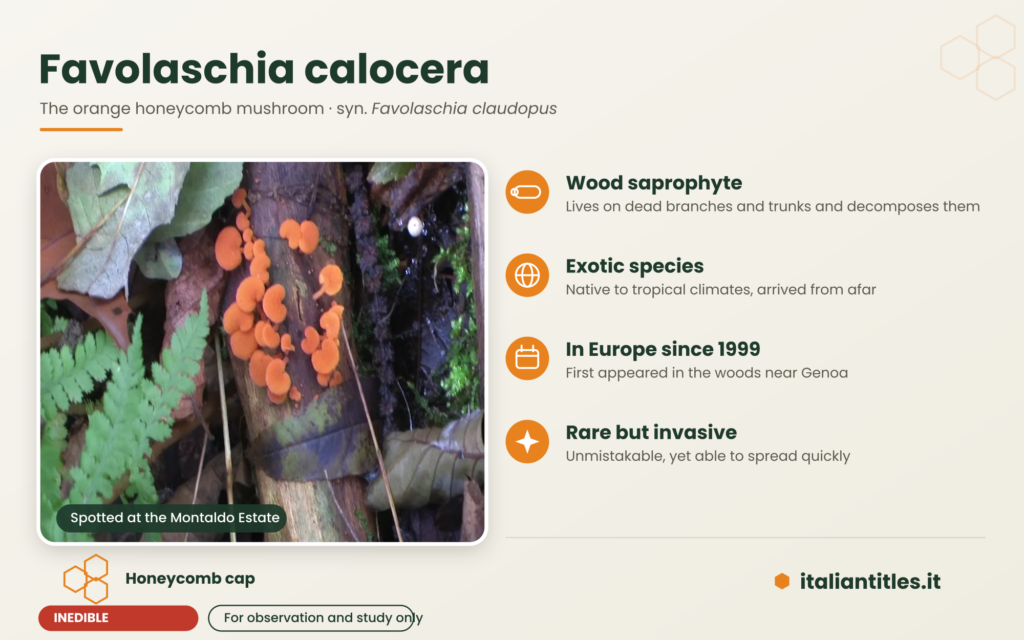
With global warming and trade between continents, species that were not here before are now arriving in our woods too. We have found one example right here: Favolaschia calocera, a small orange mushroom native to Madagascar, recorded for the first time in Europe near Genoa in 1999. Today we find it in our Estate.
It is not good news in itself — it is an alien species that can compete with native fungi — but it is a valuable signal: it tells us that the climate and ecosystems are changing before our eyes, here too among our hills.
That is why we do not believe in abandonment. A changing woodland must be watched, accompanied and helped: replanting native trees and shrubs is our way of giving strength to the species that belong here, while the world around us is transforming.
A trick of colours
There is a detail that makes this little mushroom even more intriguing. Its bright orange, so obvious to us, is almost invisible to the eyes of a roe deer: these animals are dichromats — they see blue and green well but do not perceive red and orange, which to their eyes blend into shades of green and brown, much as happens to a colour-blind person. It is the same reason hunters wear an orange vest: it stands out to their fellow humans, but not to the animals of the wood.
So what to us is a burst of colour, to the roe deer blends into the grass. And if one day, deceived, it mistook this mushroom — which is not meant to be eaten — for an ordinary morsel, it could harm itself. A small reminder of how a woodland is a delicate web of balances, where even a colour can tell a story.